Look around.
Explore the map, filter reports, and open a record for its details and source. Check the report date before drawing conclusions.
 Lantern
Explore local crime reports and stay connected to the people you care about.
Browse incidents and registry records on the map. Create a Circle, invite someone you trust, and choose when to share your location.
Explore LanternFor iPhone. Subscription required for app access.
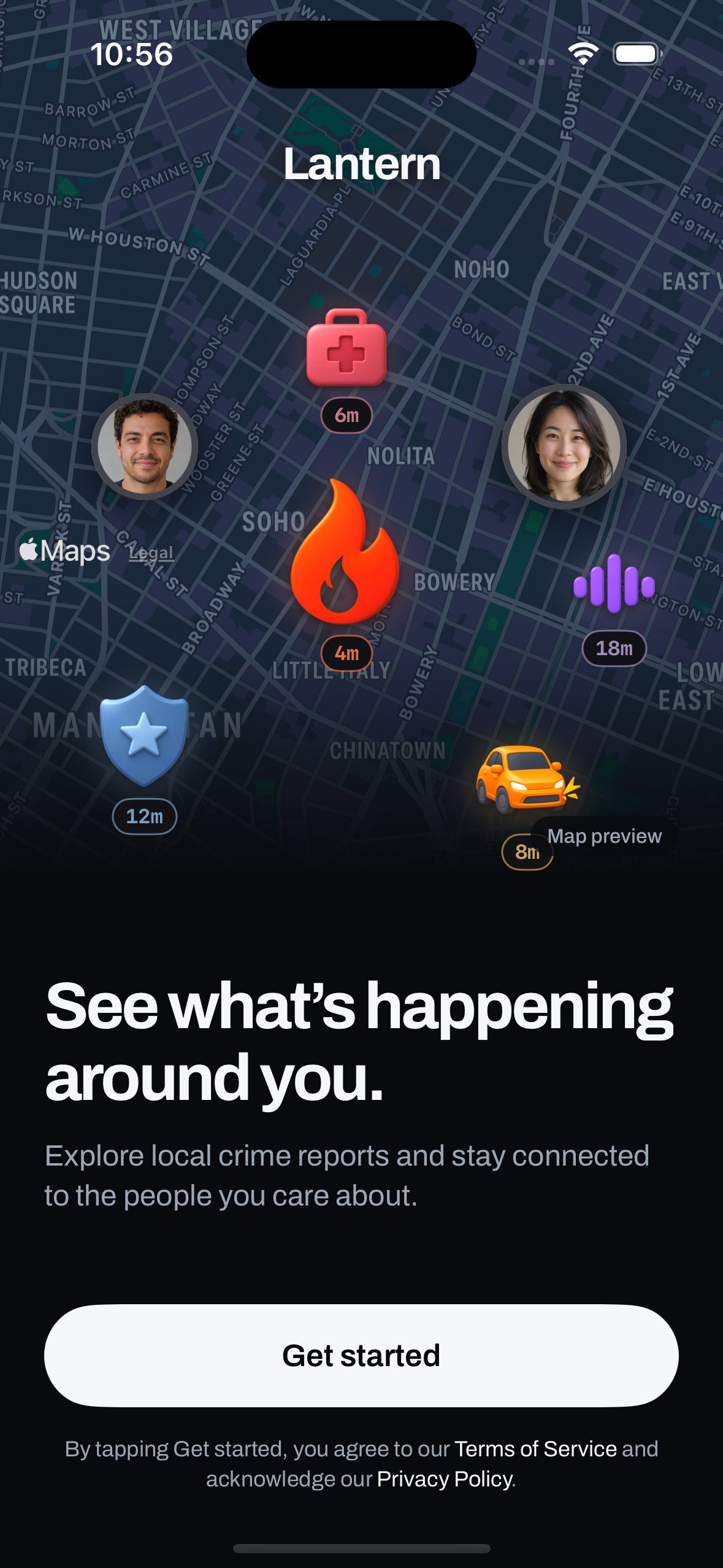
Explore the map, filter reports, and open a record for its details and source. Check the report date before drawing conclusions.
Create a device profile with a display name. Share a Circle invitation code and connect with the people you choose.
Share your latest location with specific people, pause it when you want, and send a check-in request when you need an update.
Coverage and dates are part of every record.
Lantern combines bundled historical reports with sources published through our service. Availability, dates, and completeness vary by source and location. The app identifies the source and report date; a newly imported record can describe an older event.
The bundled archive includes Chicago, New York City, and Los Angeles reports from May 12–18, 2025. Additional published sources appear in the app as they become available. These records are reports, not findings of guilt.
The registry layer is a limited sample of public records supplied through CrimeoMeter and attributed to their source. Recorded addresses and photos describe registry records; they do not show a person’s current whereabouts. Coverage is incomplete and updates can lag changes to the original registry.
Locations are shared with permission and show when they were updated. Connectivity, battery settings, and iOS permissions can delay updates. Lantern does not maintain a family location history.
Lantern is independent of the agencies whose records it displays. An empty map does not establish that an area is safe. It does not provide emergency monitoring or crime alerts.
This site provides applications using data that has been modified for use from its original source, www.cityofchicago.org, the official website of the City of Chicago. The City of Chicago makes no claims as to the content, accuracy, timeliness, or completeness of any of the data provided at this site. The data provided at this site is subject to change at any time. It is understood that the data provided at this site is being used at one’s own risk.
Source terms of useThe data made available here has been modified for use from its original source, which is Montgomery County, Maryland ("the County"). THE COUNTY MAKES NO REPRESENTATIONS OR WARRANTIES AS TO THE COMPLETENESS, ACCURACY, OR TIMELINESS OF ANY DATA. THE COUNTY EXPRESSLY DISCLAIMS ALL WARRANTIES, WHETHER EXPRESS OR IMPLIED, INCLUDING ANY IMPLIED WARRANTIES OF MERCHANTABILITY OR FITNESS FOR A PARTICULAR PURPOSE. THE COUNTY MAKES NO REPRESENTATION OR WARRANTY AS TO THE WEBISTE OR APPLICATION USING DATA DRAWN FROM DATA.MONTGOMERYCOUNTYMD.GOV OR FOR THE USEFULNESS OR INTEGRITY OF THE WEB SITE OR APPLICATION. The data is subject to change and possible deletion, temporarily or permanently. It is understood that the information contained in the web feed is being used at one's own risk.
Source terms of useBoston Police Department crime incident reports are from Analyze Boston, the City of Boston’s open data portal, and are used under the Open Data Commons Public Domain Dedication and License (PDDL). Lantern has modified the data for display: we withhold sensitive and administrative reports and reports without coordinates. The City of Boston does not endorse Lantern and makes no claims about the content, accuracy, timeliness, or completeness of the data.
Source dataset · PDDLMinneapolis 911 calls with a police response are from the City of Minneapolis open data portal and are used under CC0. The city anonymizes locations to street centerlines or larger areas. These are calls, not confirmed crimes. Lantern has modified the data for display: we withhold sensitive, medical, and administrative calls. The City of Minneapolis does not endorse Lantern and makes no claims about the accuracy or completeness of the data.
Source dataset · CC0Cincinnati Police calls for service are from the City of Cincinnati open data portal, where the city publishes them in the public domain. The city anonymizes addresses to the block. These are calls, not confirmed crimes. Lantern has modified the data for display: we withhold sensitive, medical, and administrative calls. The City of Cincinnati does not endorse Lantern and makes no claims about the accuracy or completeness of the data.
Source datasetSan Antonio Police calls for service are from the City of San Antonio seven-day map service and are used under the City of San Antonio Open Data Policy. The data is provided “as is”, without warranty of any kind. Addresses are the city’s hundred-block labels. These are calls, not confirmed crimes. Lantern has modified the data for display: we show only the source’s person-crime and property-crime categories and withhold sensitive calls. The City of San Antonio does not endorse Lantern.
Source · Open Data PolicyDallas Police Department incident reports from Dallas OpenData (City of Dallas), published under the Open Data Commons Attribution License. Attribution: Dallas Police Department. Reports and classifications may change and do not establish guilt. The city geocodes reports to street addresses, so Lantern drops the exact address, apartment, names and victim fields at fetch time, keeps only the hundred block, and rounds coordinates to three decimal places (about 100 meters). Reports without coordinates are withheld. Source clocks use Dallas civil time (America/Chicago); ambiguous daylight-saving clocks are withheld. Family-violence, sensitive, medical and administrative reports are withheld. Checked daily; coverage is incomplete and this is not a live dispatch feed.
Columbus Division of Police incident reports from the City of Columbus open data portal, dedicated to the public domain under CC0. Reports and classifications may change and do not establish guilt. The city redacts records to protect victim privacy, places reports at the hundred block and does not map some reports; unmapped reports are withheld. Reports appear about three days after creation. Source clocks are Columbus civil time (America/New_York); ambiguous daylight-saving clocks are withheld. Sensitive, medical and administrative reports are withheld. Checked daily; coverage is incomplete and this is not a live dispatch feed.
Tempe Police calls for service from the City of Tempe open data portal, licensed under CC BY 4.0. Source: City of Tempe. These are calls, not confirmed crimes. The city hides house numbers in the address but publishes unaltered points, so Lantern drops place names, unit and officer fields at fetch time and rounds coordinates to three decimal places (about 100 meters). Times use the source UTC clock, checked against the Tempe local hour (America/Phoenix, no daylight saving). Sensitive, medical and administrative calls are withheld. Checked daily; coverage is incomplete.
Denver Police Department crime offenses from the City of Denver Open Data Catalog, licensed under CC BY 3.0. Credit: City of Denver Open Data Catalog. Reports and classifications may change and do not establish guilt. The source moves sexual assaults to a separate aggregated layer. Some source addresses are exact, so Lantern keeps only the hundred block and rounds coordinates to three decimal places (about 100 meters) at fetch time. Source clocks are Denver civil time (America/Denver); ambiguous daylight-saving clocks are withheld. Sensitive, family and administrative offenses are withheld. Checked daily; coverage is incomplete and this is not a live dispatch feed.
Fort Worth Police Department crime reports from the City of Fort Worth open data portal, licensed under CC BY 4.0. Credit: City of Fort Worth Police Department. Reports and classifications may change and do not establish guilt. The source removes juvenile cases. The source geocodes reports to street addresses, so Lantern drops the address and projected coordinates at fetch time, keeps the hundred-block label and rounds coordinates to three decimal places (about 100 meters). Source clocks are Fort Worth civil time (America/Chicago); ambiguous daylight-saving clocks are withheld. Sensitive, family and administrative reports are withheld. The city updates the data once a week; coverage is incomplete and this is not a live dispatch feed.
Mesa Police dispatch events from the City of Mesa open data portal, available on an open license basis. Source: City of Mesa. These are calls, not confirmed crimes. The city places events on the hundred-block street centerline and removes the location of sensitive calls. Source clocks are Mesa civil time (America/Phoenix, no daylight saving). Sensitive, medical and administrative calls are withheld. The city updates the data daily; coverage is incomplete.
Buffalo Police Department crime incidents from Open Data Buffalo (City of Buffalo), public domain. The information is preliminary and may change; it does not establish guilt. The source rounds coordinates to three decimal places (about 100 meters). Lantern drops the source street address at fetch time and keeps only the hundred block. Source clocks use Buffalo civil time (America/New_York); ambiguous daylight-saving clocks are withheld. Sexual offenses and other sensitive incidents are withheld. The city updates the data daily; coverage is incomplete and this is not a live dispatch feed.